09.03 15:30 - 16:30
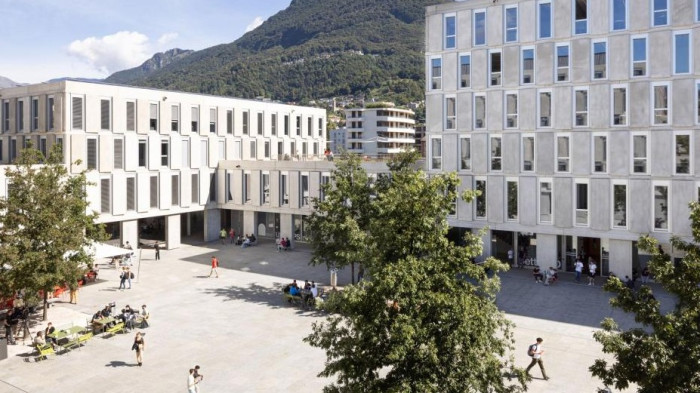
USI East Campus, Room D5.01 |
|---|
| |
|---|
Abstract: This talk presents Topological Data Analysis (TDA) via its canonical pipeline: starting from a function, mesh, or point cloud, we build a filtration and summarize the resulting topological evolution with a Persistence Diagram (PD), a multiset of planar points recording the birth and death of features. TDA is particularly effective for comparing complex datasets when coordinate-free descriptions and invariance properties are crucial. From a geometric viewpoint, PDs live in spaces of measures endowed with partial optimal transport metrics, whose non-linear structure can complicate standard data-analysis routines. This has driven work on embedding PDs into Hilbert spaces, making them directly compatible with modern machine-learning tools and advancing topological machine learning. We conclude with our recent contribution: the first explicit embedding with provable bi-continuity.
Host: Prof. Olaf Schenk | |
|---|
|
|---|
|
|
Università della Svizzera Italiana | |
|---|
|
|---|
|
|
| | Matteo Pegoraro is a postdoc in Topological Data Analysis (TDA) at the Instiute of Computing at INF/USI, funded by a FIR grant. He earned two PhDs, one from the Maths Dept. at Politecnico di Milano (2021) and one from the Informatics Dept. at Università di Bologna (2023). He then held postdoc and visiting postdoc positions at Aalborg University, KTH Stockholm, and the Inria centers of Saclay and Sophia Antipolis. His research focuses on graph shaped topological summaries such as merge trees and Reeb graphs, and on embeddings of Persistence Diagrams (PDs), a core tool in TDA, into Hilbert spaces, a foundational step in topological machine learning. His broader interests include Optimal Transport for distributional data analysis and, more recently, the statistical modeling of PDs. 15:30 |
|---|
| |
|---|
|
|
|
|